




| Availability: | In stock in Loppem |
Delivery Information
- Click here for all information regarding fast home delivery and delivery time.
- Click here for all information regarding pickup in Loppem (West Flanders, Belgium).
Product Information
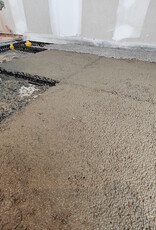
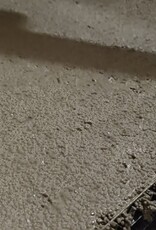
Tilable insulating screed, which is no less than 5 times stronger than our current strong tilable insulating screed version. This improved strength allows for the direct installation of floating floor coverings, such as laminate, without the need for a leveling compound or OSB layer (although a primer with a thin leveling compound layer does provide a smoother surface). Of course, it is still possible to directly glue tiles onto this substrate. Cem Mini is also suitable for use on flat roofs, where waterproofing can be directly applied. This light, insulating screed weighs 3 times less than a traditional screed, but 5 times more than the strong tilable insulating screed version.
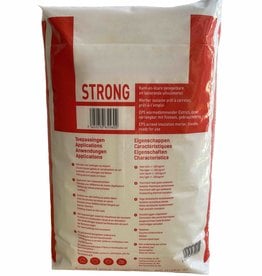
Latermix Cem Mini is a bagged ready mix ultra-lightweight insulating concrete for screed fills, screeds, roof falls, based on special Laterlite Plus expanded clay.
Mixing Latermix Cem Mini with water makes it possible to obtain a ready-to-use, lightweight, insulating and versatile concrete that can be used both indoors and outdoors for levelling, sloping, and screeding, with the possibility of direct gluing of the floor covering and waterproofing.
Latermix Cem low weight, strength, insulating capacity, finish and ease of installation, makes it ideal to reduce the dead loads on slabs and roofs, with good mechanical strength, combined with good thermal insulation and excellent durability.
Required Quantity
- Quantities: 6-6.5 liters of water per bag
- Package: bags each of 50 litres on non-returnable wooden pallets
- 50 bags/pallet = 2,5 m³/pallet
- 1 bag = 50 liters = ± 5 cm/m² = 30.8 kg
- Suggested thicknesses: ≥ 3,5 cm
- Bags required per 1 m² of floor area: ± 0,21 bags per 10 mm depth
Calculate quickly and easily here how much insulating concrete you need.
Specifications
- Apparent packed density (approx.): 600 kg/m³
- In-place density (approx.): 600 kg/m³
- Average compressive strength: 5,0 N/mm² (50 kg/cm²)
- Thermal conductivity λ: 0,142 W/mK
- Suggested thicknesses: ≥ 5 cm
- Fire reaction: Euroclass A1fl (Incombustible)
- Storage: ± 12 months in original unopened packaging, protected from moisture.
- CE marking: EN 13813 CT-C5-F1
Tiles, ceramics, stoneware, natural stone. Direct installation possible without leveling layers, but can be leveled if desired for a smoother result. Waiting time before covering: 7 days.
Thin, flexible floors (linoleum, carpet, PVC...), parquet
Covering with a moisture content of the screed less than or
equal to 3% (to be checked beforehand by carbide bomb measurement).
See also Latermix Fast - light, fast-drying screed.
Screed or concrete slab (Latermix Cem Mini used as leveling layer)
The screed/slab must be made at least after 7 days.
Laying of moisture-sensitive coverings on the screed:
place a vapor barrier between the two layers.
Downloads
Installation
SUBSTRATE
The substrate must be clean, dry, solid, and free of cracks. Provide decoupling from walls and columns through edge insulation. On a wooden floor or damp concrete substrates, lay a construction film of 0.2mm thickness.
PREPARATION OF THE MIX
Latermix Cem Mini can easily be prepared in a concrete mixer or hand mixer. Add the contents of one or more full bags of Latermix Cem Mini to the mixer/tub (without using more than 60% of the capacity); Add about 6-6.5 liters of water per bag; Mix for about 5 minutes until a paste-like and semi-liquid consistency is achieved.
APPLICATION
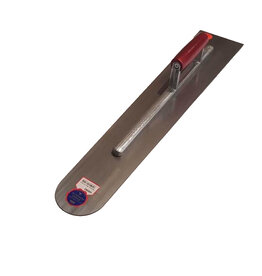
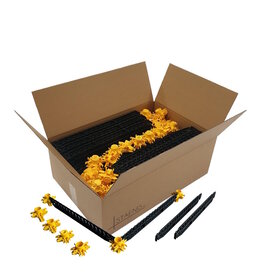
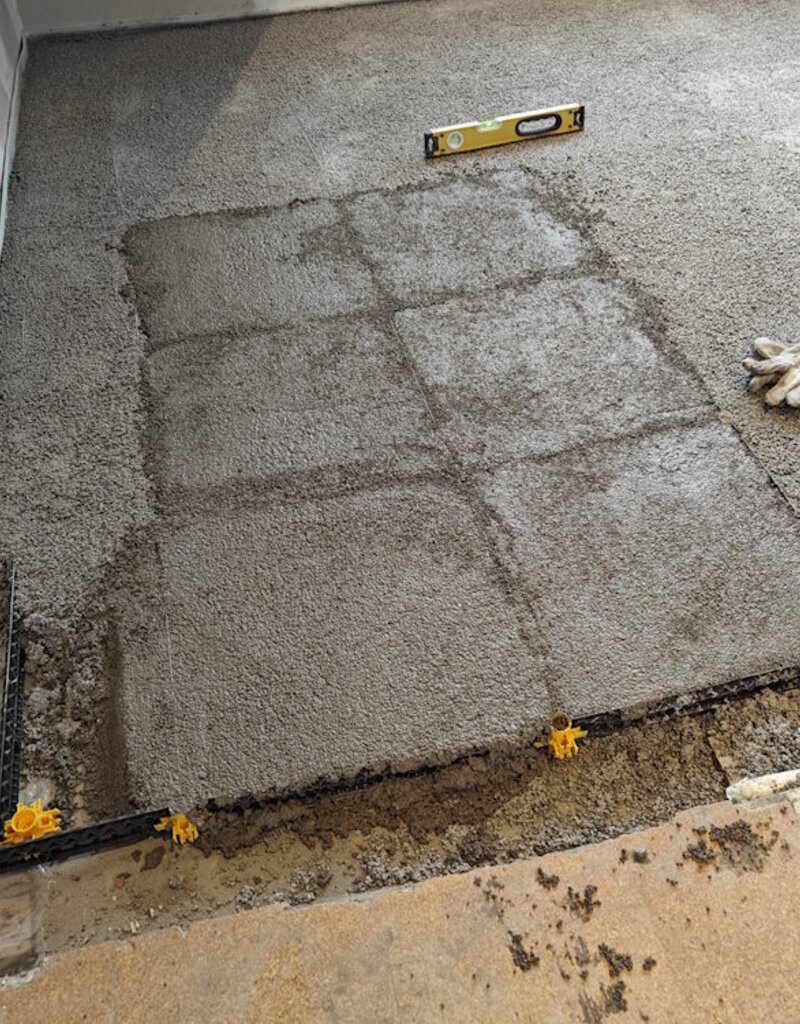
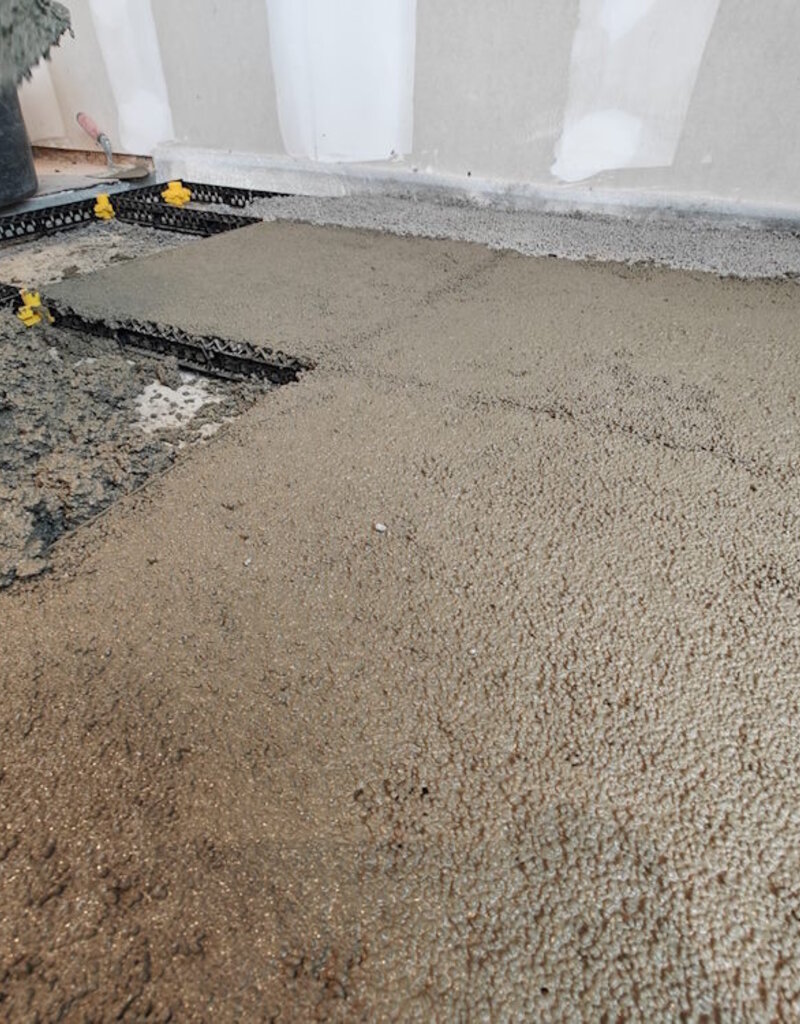
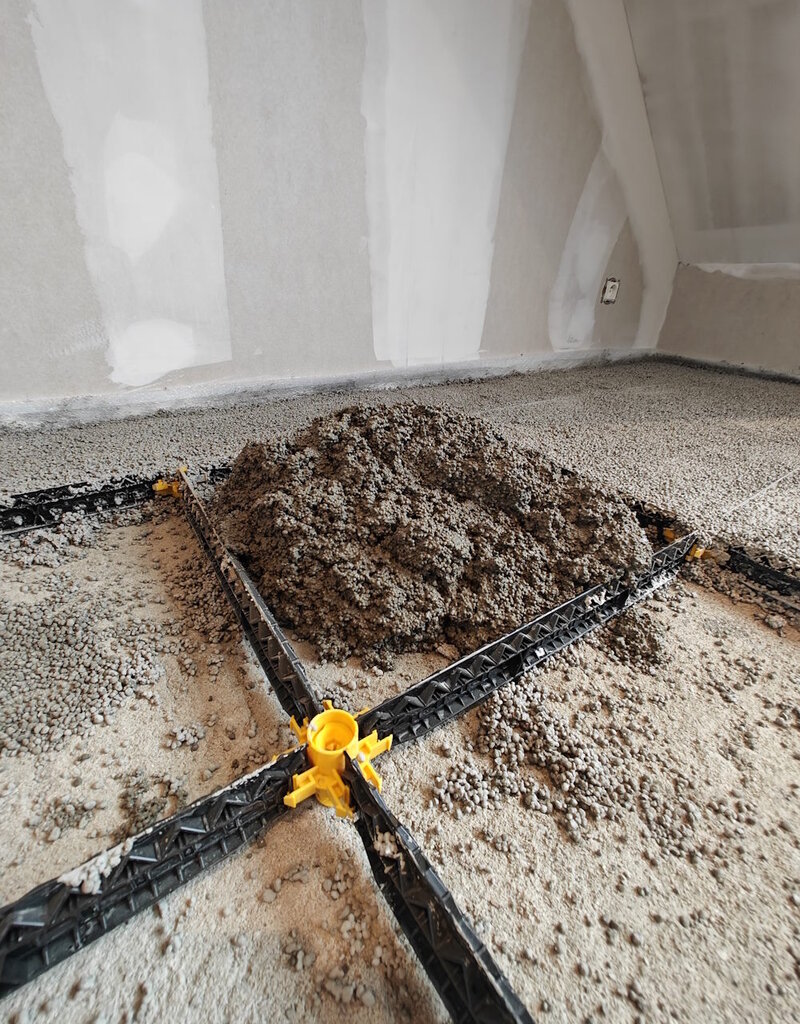
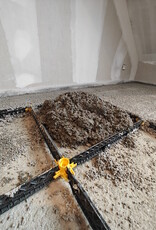
After preparing the Staenis grid, spread the mixture to the required thickness and level it with a 60 cm long trowel. It is not necessary to compact the mixture.
COVERING – FINISHES
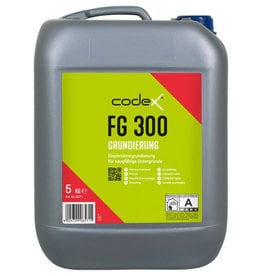
Latermix Cem Mini, having a closed structure, is suitable for the direct application of coverings (tiles or stones, waterproofing) without a leveling layer. Depending on the needs, it is also compatible with various types of self-leveling compounds. (See Paris SLIM and Codex FM10). Consult the technical sheet and product documentation for complete application instructions.
Customer feedback:
1. A mixing time of 3 minutes is indicated. That is not correct. According to the manufacturer’s instructions it must be at least 3 minutes. Better is 5 minutes for a more homogeneous mix. The mixer should be positioned as horizontal as possible and the concrete must be poured immediately, or if it takes a bit longer, stirred/turned regularly once it is in a tub/bucket. Otherwise the cement will segregate. For us, 6.2 liters of water per 50 liters of dry concrete worked well. Too little water leads to grainy, brittle concrete. You’ll see this later as the top grains come loose.
2. There are small differences between bags in the cement/aggregate ratio. It is better to mix multiple bags together rather than pouring per bag. If the entire mixed quantity is not poured immediately, the remainder should be turned over again before pouring to prevent segregation.
3. During placing and smoothing, the aggregates tend to creep under the Staenis grid, disturbing the dimensional accuracy. That’s why we placed stones on it.
4. The instructions for smoothing that apply to “normal” screed are not really applicable here. The material requires a slightly different technique for filling and spreading—rather light tamping with the screed trowel.
5. When setting the height, use a measuring rod/post with a smooth, non-adhesive underside and check regularly for contamination; otherwise the dimensions will be off due to adhering grains.
6. After pouring, the material clearly moves and shrinks, and it compacts especially in the middle. Areas not supported by a grid can break off or settle. Waiting 5 days before tiling or similar is on the short side. Better 7 days.
7. It is best to lay the grid as completely as possible, i.e., as close to the walls as possible and continuously along the walls. Lightweight concrete needs as much support as possible.
8. Avoid thin overlaps if the work is carried out with interruptions or at connections to walls, etc. During drying these can shrink loose and break.
9. In our case it was a solution, because with a small thickness of 9 cm we could still pour insulating concrete, whereas with conventional techniques we would have had to break out and excavate everything. The grid performs well and was indispensable in this case.
10. We installed a leveling underlayment of 10 mm over the concrete without smoothing it with cement. The parquet floor went on top. It just works. With thinner underlayments, leveling is absolutely necessary.
| Content per bag: | 50 litres |
| Number of bags per pallet: | 50 |
| Weight per bag: | 30,8 kg |
Find the order you'd like to withdraw
Enter your email address and order number.
Check your mailbox
If your details match an order, you'll receive an email with a link to view and manage it.